
UQ chemical engineers have developed a new approach to carbon capture that could help reduce emissions from industries people rely on every day, including power generation and manufacturing.
The research, led by Prof Xiwang Zhang and Dr Mike Tebyetekerwa from UQ School of Chemical Engineering and published in Science Advances, demonstrates a system that can capture carbon dioxide using less energy than many existing methods.
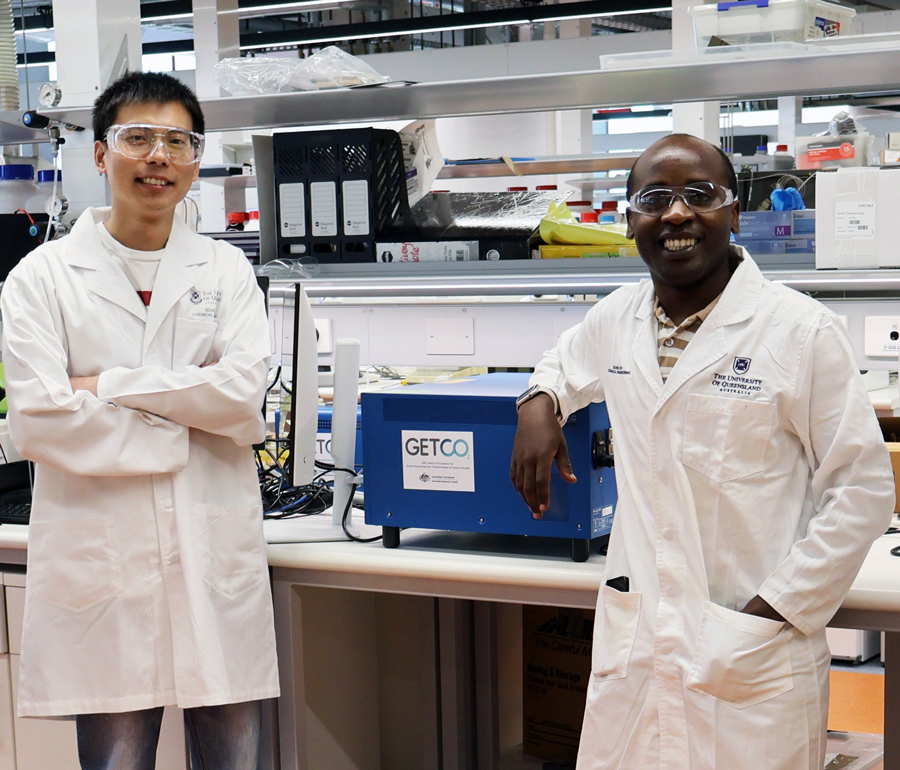
The team designed a device that works in a similar way to a supercapacitor. By applying a small amount of electricity, the system captures carbon dioxide from gas streams and then releases it again when needed.
Capturing carbon dioxide is an important part of reducing greenhouse gas emissions, particularly in sectors that are difficult to decarbonise. However, current technologies are often energy-intensive and rely on complex chemical processes.
Prof Zhang said the new system offers a simpler and more efficient alternative.
“If we intend to lower emissions from industries that remain vital to our economy, carbon capture is crucial,” he said.
“Our system shows that it is possible to capture carbon dioxide efficiently using electricity and low-cost materials, without relying on complex chemical processes.”
Instead of relying on traditional chemical reactions, the UQ team used abundant carbon materials and a specialised membrane to control how charged species move within the system. This creates a local environment where carbon dioxide can be captured and stored more efficiently.
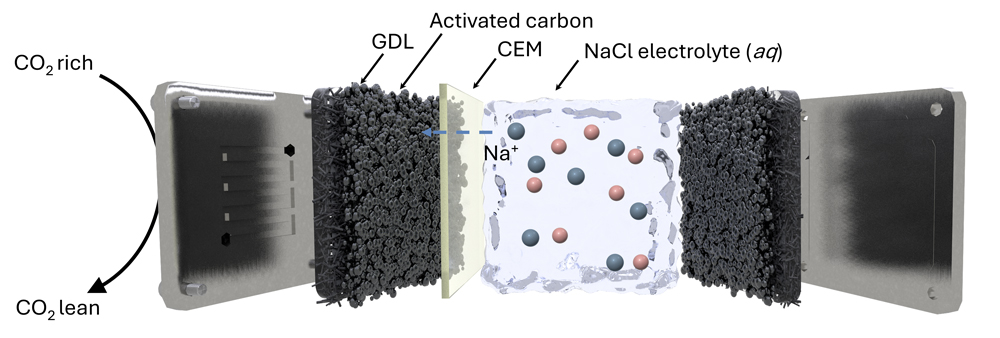
The process takes place at a thin interface, where gas, liquid, and electricity interact at the surface of the material.
“This approach allows us to capture carbon dioxide quickly and effectively,” Dr Tebyetekerwa said. “That reversibility is important for practical applications, where the gas needs to be both captured and reused or stored.”
The system demonstrated strong performance, achieving high capture rates while using less energy and maintaining stable operation over time.
Professor Xiwang Zhang said the work highlights the importance of designing smarter systems using simple materials.
“What is exciting is that we are achieving strong performance using accessible materials and smart engineering,” Professor Zhang said. “That is essential if carbon capture technologies are to be scaled up and used in real industrial settings.”
The technology is designed to work with gas streams similar to those produced by industrial processes, making it particularly relevant for reducing emissions from large scale operations.
Research fellow, Dr Kaige Sun, and first author, said understanding how the system works at a fundamental level was key to improving its performance.
“We were able to pinpoint exactly where and how carbon dioxide is captured in the system,” Dr Kaige Sun said.
“That insight helps us refine the design and improve efficiency.”
While further development is needed before the technology can be deployed at scale, the team says it offers a promising pathway toward more energy efficient carbon capture and cleaner industrial processes.
The research is supported by the Australian Research Council (ARC) through ARC Centre of Excellence for Green Electrochemical Transformation of Carbon Dioxide (GETCO2) and Discovery Early Career Researcher Award (DECRA) (to Dr Mike Tebyetekerwa)
Access the paper in Science Advances here


