
When grade 11 student, Sophie Morse first walked through UQ’s Andrew Liveris Building as part of a Women in Engineering Spring into Engineering program, she was captivated by what she saw.
Home to researchers tackling challenges spanning sustainable materials, advanced manufacturing and carbon capture, the School of Chemical Engineering offered a glimpse into how engineering research can help shape a more sustainable future. For the St Aidan’s student, it sparked a curiosity she couldn’t ignore.
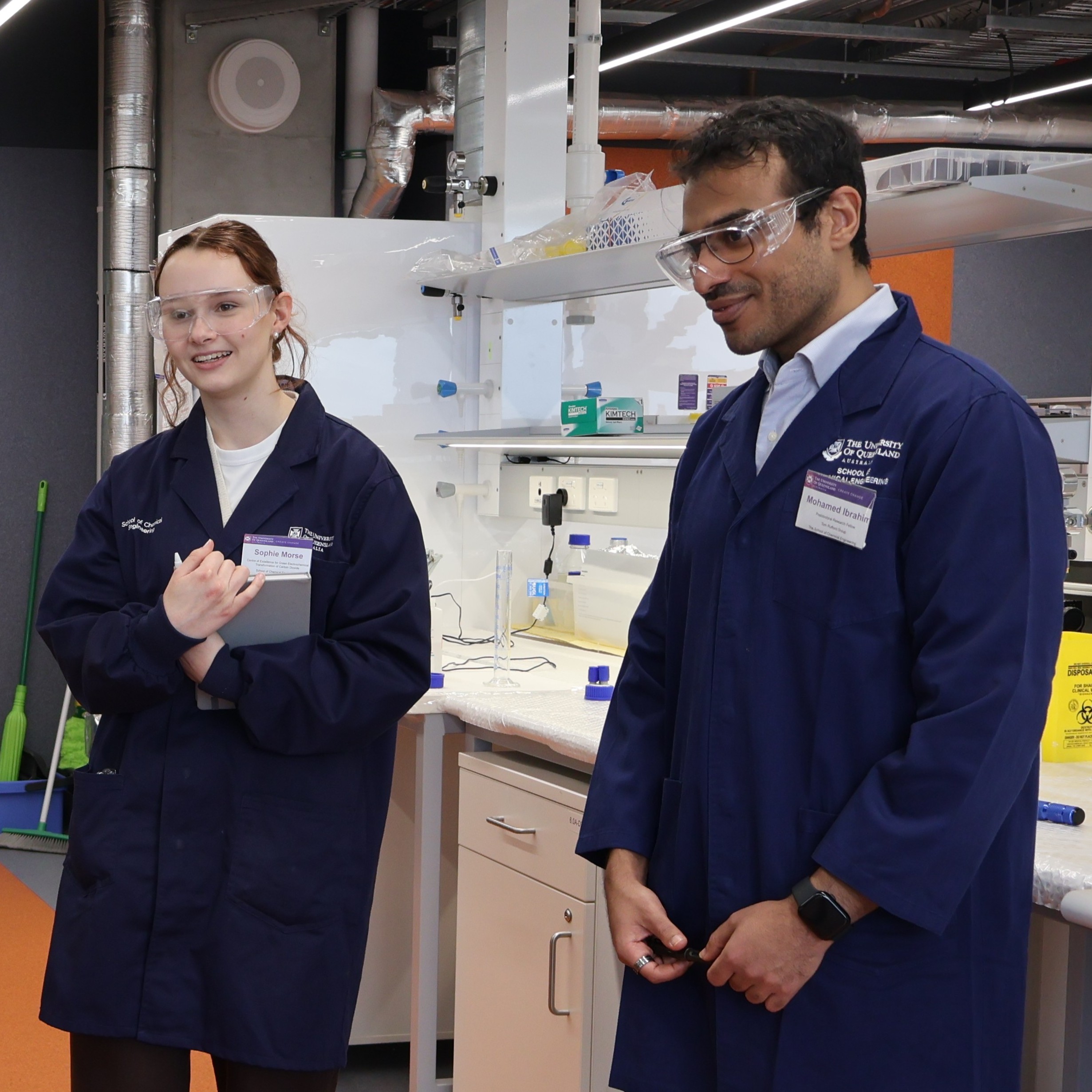
“Seeing the incredible labs was a real highlight for me,” Sophie said.
“It sparked my curiosity about applying the chemistry we studied in school to sustainability and biomaterials.
“It seemed like an exciting merger between my love of science and my concern for environmental issues.”
That curiosity eventually led Sophie to spend a week with researchers at UQ’s GETCO2 Centre, where she worked alongside experts developing technologies designed to capture carbon dioxide and convert it into useful products.
The experience introduced Sophie to the breadth of chemical engineering research, from sustainable biomaterials to electrochemical technologies.
“I was fascinated by all the different applications of a single type of biomass, from nanopaper to electrodes,” Sophie said.
“Beyond biomaterials, I learnt about the electrochemical engineering happening in the GETCO2 labs to create efficient carbon capture cells.
“What surprised me most was that I got to construct a carbon capture cell myself.”
For Sophie, the opportunity to experience a world-class research environment firsthand was just as valuable as the science itself.
“Getting to work with actual researchers, surrounded by incredible facilities and technology, was so inspiring,” she said.
“Witnessing the team’s expertise, and more importantly their willingness to share it with me, is something I’ll value for the rest of my life.”
The experience also transformed her understanding of what chemical engineers do and the impact they can have.
“This experience has really demystified what it means to be a chemical engineer,” Sophie said.
“I had previously expressed my interest in being a chemical engineer, but all I really knew was that you took chemistry and applied it somehow.
“I now know there are so many different opportunities, from electrochemical engineering to biomaterials and sustainable manufacturing.”
Professor Darren Martin, from the School of Chemical Engineering who organised the experience, said helping students understand the possibilities within engineering was an important outcome.

“Many students are interested in science and sustainability but have only a limited understanding of the careers available to them,” Professor Martin said.
“Through her time with our researchers, Sophie was able to see firsthand how chemical engineering can contribute to areas such as carbon capture, renewable materials and sustainable technologies.
“Her comment that the experience had ‘demystified’ what it means to be a chemical engineer was particularly rewarding because that understanding is so important when students are considering future study and career pathways.”
Professor Martin said Sophie also made a strong impression on everyone she met during her time with the Centre.
“Sophie was endlessly curious throughout her time with us,” he said.
“She embraced every opportunity to learn, asked thoughtful questions and was an absolute delight to host.”
Now announced as St Aidan’s School Captain for 2027, Sophie hopes other students will embrace opportunities to explore their interests.
“My biggest advice would be to seek out opportunities to explore what you are curious about,” she said.
“Through talking to experts and experiences like this, I’ve learnt so much about what it means to be a researcher and chemical engineer, and it has only made me more excited about pursuing a career in science and sustainability.
“Even if you decide a particular area isn’t for you, you’ve still learnt something new, and that in itself is invaluable.”
Find out more about Chemical Engineering at UQ and check out our Spring into Engineering Program.


